
Best Accounting Software in Saudi Arabia 2026: 5 Compared
Snad, Qoyod, Daftra, Wafeq and Zoho Books: five programs on one table with their prices, sourced wherever they publish them, and tax compliance — and the verdict depends on your own case.
In this article12 sections
The best accounting software in Saudi Arabia is the cloud accounting software that passes ZATCA Phase Two first, then fits the add-ons you need. For accounting alone, compare Zoho Books, Qoyod and Wafeq. For accounting plus POS, inventory and payroll, Snad costs SAR 0, then 149, then 399 a month. We compare five programs on official prices (August–November 2026).
Rule one: rule out anything that is not tax compliant
Choosing accounting software in Saudi Arabia starts with one hard filter: ZATCA e-invoicing. A business registered for Value Added Tax (VAT) must issue digitally signed electronic invoices integrated with the Fatoora platform under the Phase Two waves, which have progressively covered most taxpayers.
So ask any provider, local or global: does its software issue invoices integrated with the Fatoora platform directly, or through a third-party intermediary, with the cost and complexity that come with it?
We compare five programs here: Snad, Qoyod, Daftra, Wafeq and Zoho Books — all of them state e-invoicing compliance, with differences in the plan where Phase Two starts (see the table below). This is where the real comparison begins.
How to judge accounting software
- Compliance in depth, not as a slogan: issuing an approved invoice is one thing; generating a VAT return in ZATCA's own format automatically is something deeper — the return calculator gives you a sense of the arithmetic.
- Real Arabic: a complete RTL interface with bilingual reports and invoices, not patchy machine translation.
- Pricing and its currency: published in SAR? In a fluctuating dollar? Or "contact us"?
- Plan caps: the number of users, the number of invoices per month, and the fee for an extra branch.
- Beyond accounting: when you later need inventory, a POS or payroll — add-ons you buy? separate products? or inside the same system?
The Saudi category: Snad, Qoyod and Wafeq
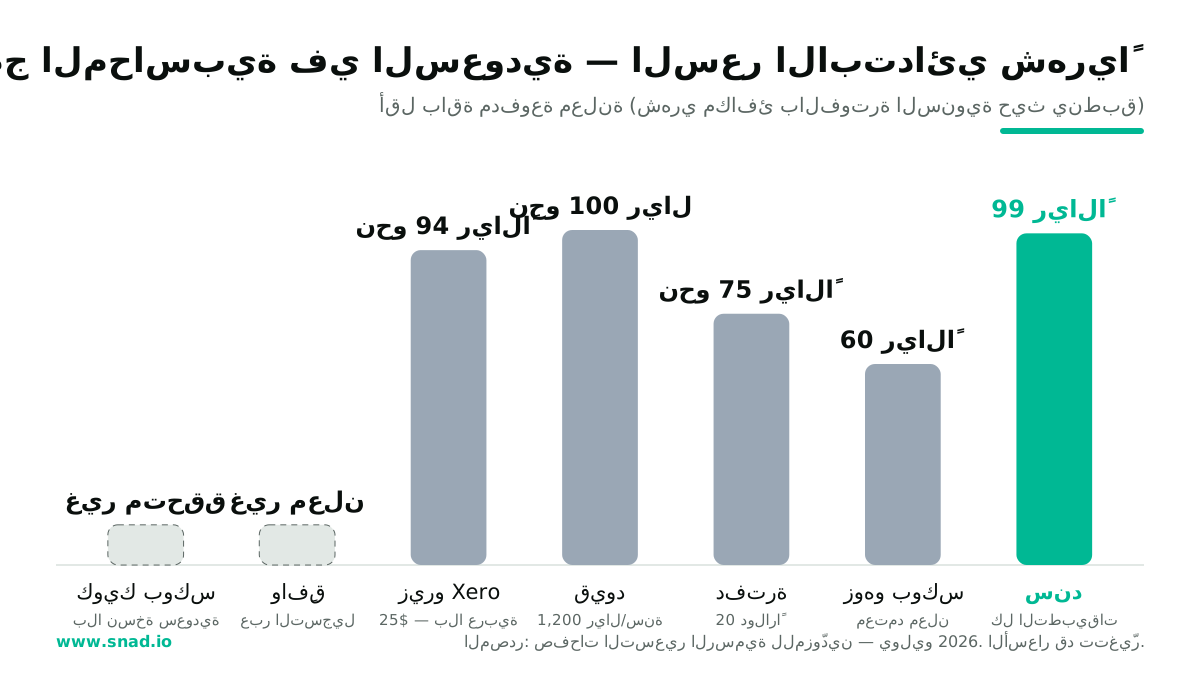
Snad — a complete general ledger with journal entries created automatically from every transaction (a sale on the POS, a salary payment, an inventory purchase), e-invoicing for both phases built in, and instant financial reports. Our strength: the accounting feeds itself, because sales, inventory and payroll sit in the same system, so there is no double entry and no integrations to break. Our prices are published: SAR 0, then 149, then 399 per month, with every app on Pro.
Qoyod1 — a Saudi cloud accounting product with three plans (Basic, Pro and Advanced), its help center states there is no maximum limit for invoices, entries, products, customers or suppliers, and its website states it is approved by the Zakat, Tax and Customs Authority for Phase Two, with the linkage from the Pro plan upward. Watch the add-on structure: point of sale is a paid add-on per user and payroll a paid add-on per employee on top of the plan, per its help centre (November 2026); its plan and add-on prices are on its pricing page.
Wafeq2 — an accounting and invoicing product focused on Saudi compliance, with dedicated Phase Two pages, a documented e-invoicing API and a certified partner and accountant programme. Its plans start at SAR 99 per month on annual subscription (119 monthly) (per Wafeq's pages — November 2026); point of sale is not listed among its products (November 2026), and payroll starts from Premium.
The broad Arabic category: Daftra
Daftra3 plays a different game: instead of pure accounting depth, it offers wide scope — accounting, invoicing, inventory, POS, HR and asset management — on a plan starting at SAR 95 per month on annual billing, 120 on monthly (November 2026).
Its strength: a competitive scope-to-price ratio, POS with no device limit on any plan that works offline with a paid add-on, and 24/7 support (per its pricing page — August 2026).
Its limits: a monthly invoice cap and a customer cap on the two lower plans (100 invoices per month and 100 new customers on the Basic plan, per its pricing page), Phase Two e-invoicing starting from its Advanced plan (Basic covers Phase One), and a focus spread across several Arabic markets — Saudi localisation is present among the several markets it serves.
If your equation is "the widest scope at a competitive price," Daftra is a competitor to take seriously.
The global category with a Saudi pricing page: Zoho Books
Zoho Books4 is the global exception that took the Saudi market seriously: a pricing page in SAR (from SAR 60 per month on annual billing, excluding local taxes), a permanently free plan for businesses whose annual revenue does not exceed SAR 200,000, and Phase Two e-invoicing from the Standard plan (per its official pricing page — August 2026).
Its strength: a low entry price, a permanently free plan that includes bank reconciliation, a customer portal and 50+ reports, API access from Standard, and the Zoho app ecosystem.
Its limits: it is an accounting product — advanced inventory, payroll, HR and CRM are separate Zoho products, each bought and configured on its own — the Standard plan includes three users, with each additional user at SAR 10 per month (8 billed annually), and prices exclude local taxes.
For a freelancer or a micro business, its free plan is a strong offer. For a business that will grow, add up the total of the separate products two years out.
Global products we have not sourced: QuickBooks and Xero
We mention them because you will meet them on every global list. We have not sourced their prices, their Arabic interface or their Fatoora integration from their providers' own pages, so we pass no verdict on them here and leave them out of the table.
If your business is registered for VAT and you are considering either one, ask the provider three questions before you subscribe: does the software issue invoices integrated with the Fatoora platform for Phase Two directly, or through a third-party app? Are its interface and invoices in Arabic? And what currency does it charge in? Then add the cost of any intermediary to the price.
The full comparison table
Figures per the providers' official pages — August 2026. "—" means a point we could not source from the provider's own page, and Qoyod's prices are on its pricing page:
| Criterion | Snad | Qoyod | Daftra | Wafeq | Zoho Books |
|---|---|---|---|---|---|
| Starting price | SAR 0 then 149 including VAT | on its pricing page | SAR 95 (annual; 120 monthly) | from SAR 99 on annual subscription (119 monthly) | SAR 60 (annual, excluding taxes) |
| Currency | SAR | SAR | SAR | SAR | SAR |
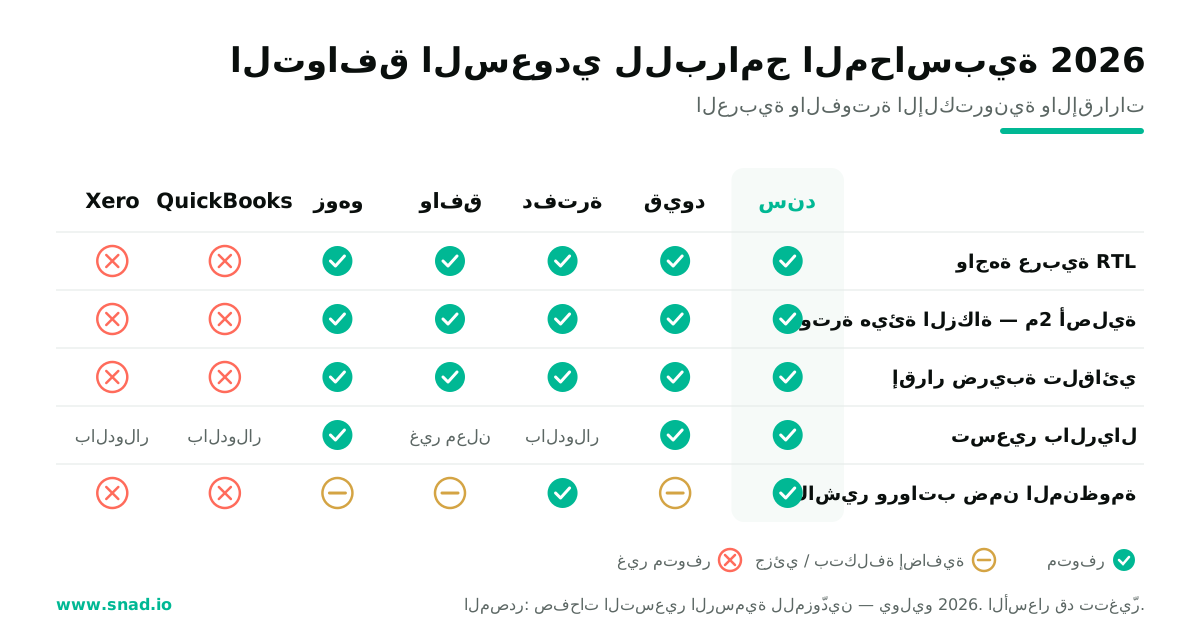
| Arabic RTL interface | ✓ | ✓ | ✓ | ✓ | — |
| ZATCA e-invoicing — Phase 2 | ✓ from Basic | Approved for Phase Two; linkage from Pro upward (November 2026) | from the Advanced plan | ✓ | ✓ from Standard |
| Inventory | ✓ in the plan | could not be documented | ✓ | — | advanced is a separate product (Zoho Inventory) |
| POS and payroll | ✓ in the plan | paid add-ons | ✓ | payroll from Premium; POS not listed among its products (November 2026) | payroll is a separate product |
| Free plan | ✓ | could not be documented | not listed | — | ✓ with a revenue condition |
The real cost: beyond the plan price
The plan price is the start of the line, not the end of it. Always add up:
- The add-ons you will actually need: a POS for the shop? payroll for your two employees? With Qoyod that is two paid add-ons, with Zoho payroll is a separate product, and with Snad and Daftra it sits inside the plan.
- User and extra-branch fees: an additional user is a paid add-on with Qoyod (the price is on its pricing page), SAR 10 per month (8 billed annually) with Zoho Books, SAR 35 per month on Daftra's monthly billing (26.25 on annual billing), and SAR 20 per month on Snad's Basic and Pro.
- The cost of a tax intermediary if you pick software that does not integrate with Fatoora directly — a second full subscription.
- The currency you pay in: if the system prices in dollars (as some global systems do), add transfer fees and exchange-rate swings.
- The cost of switching later: the cheapest option today can cost you a full migration two years from now as you grow — pick a system with room for your growth, or make sure your data is easy to export.
A practical rule: estimate what you will need 24 months from now (users, branches, POS, payroll) and price each system at that point, not at the starting point.
Which one is best for your case?
- Freelancer or micro business (accounting only): Zoho Books free, then SAR 60, or Snad's free plan if you want an open door to expand later.
- Small business that wants accounting alone with Saudi depth: Qoyod or Wafeq — weigh Qoyod and its add-ons (its help center states there is no maximum limit for invoices — November 2026) against Wafeq's API and partner programme.
- A business that needs accounting + POS + payroll together: here the question shifts from "the best accounting software" to "the best business system" — Snad on a single plan from SAR 149, or Daftra on its broad plan.
- An accounting firm managing multiple clients: Wafeq, with a certified partner and accountant programme and an accounting-firm directory, and Zoho Books, with an accountant seat even on its free plan.
- A branch of a foreign company bound by central policy: ask the provider of the software you are required to use about Fatoora integration for Phase Two before you adopt it, and take the full cost into account.
And one rule that comes before all of the above: try before you buy. Daftra and Wafeq offer a 14-day trial with no card, Zoho Books has a permanently free plan with a revenue condition (August 2026), and the 7-day Snad trial needs no card, followed by the permanently free Starter plan with one user and two apps.
The comparison in brief, with its sources
The provider figures below come from each provider's own official page, on the access date given with each line. Prices change, so check the provider's page before you subscribe.
- Daftra: A widely adopted Arabic program serving several Arab markets, covering accounting, invoicing, point of sale, HR and fixed-asset management with three depreciation methods plus a no-depreciation option, per its asset-management page (November 2026). Published pricing on annual billing (monthly billing in parentheses): Basic SAR 95/month (120), Advanced 155 (220), Comprehensive 225 (320) (daftra.com/plans). Phase Two e-invoicing starts from the Advanced plan; Basic covers Phase One. The Basic plan is capped at 100 invoices/month and one user. (Source: daftra.com/plans — accessed 3 November 2026, depreciation methods accessed 3 November 2026; daftra.com/plans5 · daftra.com/en/asset-management6)
- Qoyod: An established Saudi accounting system whose help center states there is no maximum limit for invoices, entries, products, customers or suppliers (November 2026). Point of sale and payroll are paid add-ons on top of the plan, the first per user and the second per employee, according to its help centre — November 2026. (Source: Qoyod help center — accessed 3 November 2026; qoyod.com/en/knowledge-base/qoyod-pricing-plans-features-pricing-limits-how-to-choose-an7 · qoyod.com/en/knowledge-base/qoyod-plans-and-pricing-subscription-tiers-features-add-ons8)
- Wafeq: A clear focus on Saudi compliance with Phase Two pages and a QR reader, a documented e-invoicing API, and a certified partner and accountant programme. Published pricing on annual subscription (monthly in parentheses): Starter SAR 99 per month (119), Plus 119 (149), Premium 199 (249), and Enterprise on request. Phase Two e-invoicing starts from Plus, and payroll and inventory from Premium. Point of sale is not listed among its announced products (November 2026). (Source: Wafeq's own pages — accessed 3 November 2026; wafeq.com/ar-sa/wafeq-vs-daftra9 · wafeq.com/ar-sa2 · wafeq.com/ar-sa/wafeq-vs-qoyod10)
- Zoho Books: A genuinely permanent free plan for businesses below a given revenue threshold, and a large ecosystem of apps that integrate with it. Published pricing: From SAR 60/month with annual billing (the Saudi pricing page). An accounting product: HR, CRM and advanced inventory are separate Zoho products. Phase Two e-invoicing starts on the Standard plan, and prices exclude local taxes. (Source: zoho.com — Saudi pricing, accessed 19 August 2026; zoho.com/sa/books/pricing11 · zoho.com12)
Next: Accounting in Snad · What accounting software costs in Saudi Arabia · Free accounting software: what the free plan covers · Qoyod vs Daftra, from official sources
Frequently asked questions
- What is the best accounting software in Saudi Arabia in 2026?
- For plain accounting at a low cost: Zoho Books (from SAR 60 per month billed annually, with a free plan subject to a revenue condition, and Phase Two from the Standard plan). For specialised Saudi accounting: Qoyod or Wafeq. For anyone who needs accounting together with POS, inventory and payroll in one system: Snad from SAR 149 per month for five apps, all nine on Pro. The right choice is set by the scope of your needs, not by the name of the software.
- Does my company need Phase Two e-invoicing from its accounting software?
- If your company is a VAT taxable person resident in the Kingdom, the E-invoicing Regulation13 (Article 3) applies to it, so plan for Phase Two. ZATCA announced the twenty-fifth wave on 24 July 2026: taxpayers whose VAT-subject revenue exceeded SAR 187,500 in 2022, 2023, 2024 or 2025 must integrate with the Fatoora platform by 1 February 2027 at the latest, and ZATCA notifies them directly (zatca.gov.sa, accessed 18 November 2026). Check your own wave with the wave 25 checker. Then choose software whose plan includes the linkage: Snad accounting includes it on Basic and Pro, not on Starter, and e-invoicing in Snad explains both phases.
- Is QuickBooks compliant with ZATCA?
- We have not sourced QuickBooks' status from its provider's own page, so we pass no verdict on it here. Ask the provider before you subscribe: does the software issue invoices integrated with the Fatoora platform for Phase Two directly, or through a third-party app? If it is a third-party app, add its subscription to the cost. Snad integrates with Fatoora from the Basic plan.
- How much does accounting software cost for small businesses?
- Per the official pages in August 2026: from free (Zoho Books' conditional plan and Snad's Starter plan) to paid plans starting at SAR 60 per month billed annually for Zoho Books (excluding taxes), 149 for Snad including VAT, 95 for Daftra and 99 for Wafeq (annual subscription); Qoyod's prices are on its pricing page. Add the cost of add-ons if you need a POS or payroll from a vendor that sells them separately.
- What is the difference between accounting software and an ERP system?
- Accounting software keeps the books, the invoices and the financial reports and stops at that boundary, so you need other systems for POS, deep inventory and payroll, all wired back into it. An ERP such as Snad runs all of those operations from a single database, so the journal entries are generated automatically from every transaction. The rule: if your operations are broader than the books, an integrated system saves you double entry and fragile integrations.
- Is free software enough to run my company's accounts?
- It may be enough at the start: Snad's free plan includes one user and two apps, and Zoho Books is free for businesses whose revenue does not exceed SAR 200,000 a year, with one user plus an accountant and up to 1,000 invoices a year. But watch the limits: a single user, invoice ceilings, and no advanced features. Free is excellent for testing and for the beginning of a business, and at your first hire or first branch you will need a paid plan — budget for it from day one.
- Can I switch accounting software in the middle of the fiscal year?
- You can, but the cleanest move is at the start of a fiscal year or a new quarter: export the closing balances for accounts, customers, suppliers and inventory from your old system, import them as opening balances in the new one, and keep the old system read-only for a reference period. Run both in parallel for at least one month — Snad's 7-day trial needs no card, and the permanently free Starter plan lets you keep the parallel run going at no cost.
- Do I need an accountant to run the software?
- Modern cloud software is designed for the business owner to run: a ready-made chart of accounts, default tax settings, and entries generated automatically from transactions. An accountant remains important for review, the annual close and tax advice.
- What is the difference between cloud and on-premise accounting software?
- Cloud software needs no installation, updates itself and can be reached from anywhere, and it costs a recurring subscription. On-premise software is installed on your own machine and you own the license, but you carry the backups, the updates and system compatibility.
Sources
External links in this article, in the order they appear.
- 1Qoyodqoyod.com
- 2Wafeqwafeq.com
- 3Daftradaftra.com
- 4Zoho Bookszoho.com
- 5daftra.com/plansdaftra.com
- 6daftra.com/en/asset-managementdaftra.com
- 7qoyod.com/en/knowledge-base/qoyod-pricing-plans-features-pricing-limits-how-to-choose-anqoyod.com
- 8qoyod.com/en/knowledge-base/qoyod-plans-and-pricing-subscription-tiers-features-add-onsqoyod.com
- 9wafeq.com/ar-sa/wafeq-vs-daftrawafeq.com
- 10wafeq.com/ar-sa/wafeq-vs-qoyodwafeq.com
- 11zoho.com/sa/books/pricingzoho.com
- 12zoho.comzoho.com
- 13E-invoicing Regulationzatca.gov.sa