
The Best HR Software in Saudi Arabia 2026 — Jisr, Bayzat, ZenHR and Snad Compared
GOSI, wage protection, Mudad, end-of-service: we judged the HR systems operating in Saudi Arabia on compliance before anything else — with sourced prices and stated limits.
In this article15 sections
In Saudi Arabia, the best HR software is the one you choose on compliance before interface: automatic General Organization for Social Insurance (GOSI) contribution calculations, Wage Protection System files in the format the Mudad platform expects, and end-of-service awards computed under the Saudi Labor Law. This sourced review (August 2026) compares Jisr, Bayzat, ZenHR, Zoho, Odoo and Snad, explains where the government-mandated Mudad platform actually sits, and draws the distinction that decides most purchases — a dedicated HR product that still needs an accounting system beside it, versus one system that runs payroll and the books together.
In Saudi Arabia, HR software is a compliance decision first
In other markets you pick HR software on the strength of its interface or its reports. In Saudi Arabia you pick it on one question first: will it keep you compliant?
Your business — however small — is required to handle:
- GOSI: contributions calculated at the correct rates according to the employee's nationality and registration date, and paid every month — the GOSI calculator shows you the numbers.
- Wage protection: a mandatory programme covering every private-sector establishment, right down to those with one to four workers (the final phase took effect in December 2020), with the Mudad platform as the official channel for proving it through a monthly upload within 30 days.
- The Saudi Labor Law: end-of-service awards, leave entitlements and overtime — the end-of-service calculator shows you the size of the liability you are accruing.
Every product in this comparison is judged against that yardstick before any other feature. And as in every article in this series: we are the Snad team and we have a declared interest, which is why the figures below are sourced from the vendors' own websites (August 2026) and why our own gaps are named out loud.
The five comparison criteria
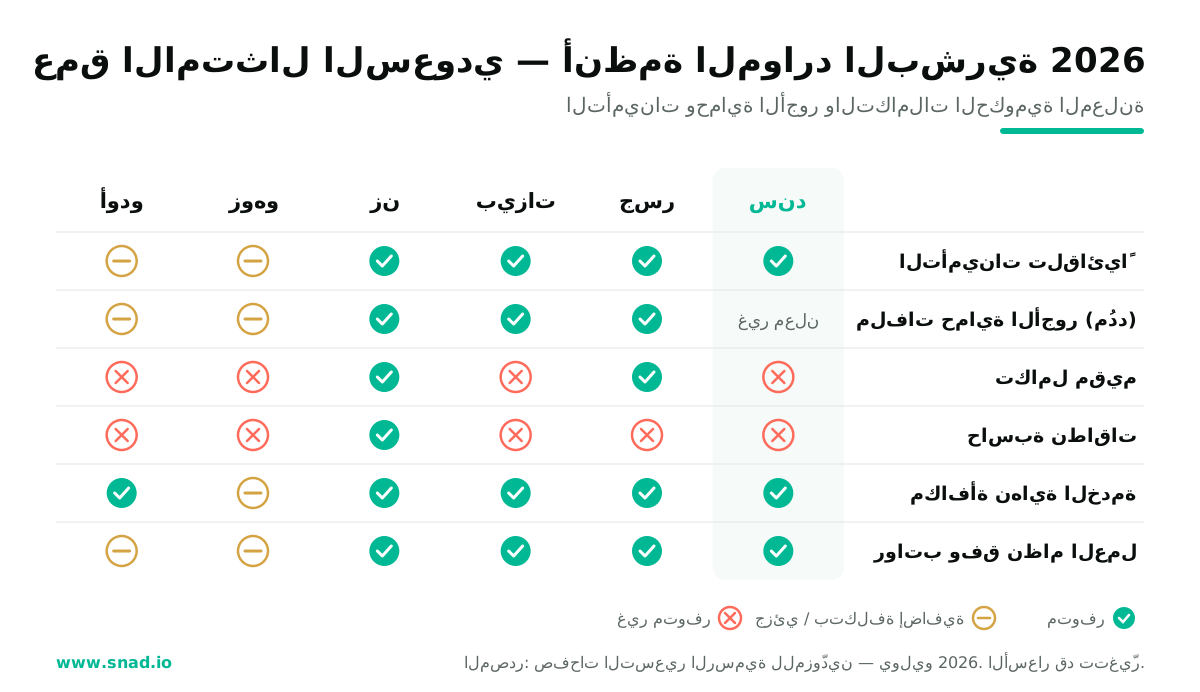
- Depth of Saudi compliance: automatic GOSI calculation? Wage protection files in Mudad's format? Muqeem integration? A Nitaqat calculator?
- Scope of the system: is it HR only — meaning you also buy accounting software with its own invoice and its own integration — or is it part of a single business system?
- Pricing transparency: is the price published on the website, or is it "request a quote", meaning sales calls and negotiated numbers?
- Pricing model and what it does as you grow: per employee per month (which inflates with every hire), or a flat plan?
- Arabic support and local presence: a team that understands "Nitaqat" and "Muqeem" without an explanation.
About Snad
Snad — payroll and HR inside one complete business system
HR in Snad is not a separate product you connect to your accounting; it is one app inside a single business management system: the payroll run posts its accounting entries automatically, and payroll cost lands in your financial statements without an export-and-import round trip.
What we offer, on the record:
- Attendance-based payroll — overtime, absence, lateness and unpaid leave — with its journal entry, plus leave and attendance management.
- HR in every plan: like the rest of our apps, it is available even on the free plan; pricing is SAR 0, then SAR 149, then SAR 399 per month depending on the plan — priced by users, not by headcount, so a 50-employee business run by an accountant and a manager costs the same as a 10-employee one.
- Accounting, e-invoicing and inventory in the same system.
Jisr — a Saudi HR platform in three bundles
Jisr1 is a Saudi HR specialist platform packaged in three bundles: core HR, talent management (recruitment and performance reviews), and expense management (travel booking and receipt automation) — per its pricing page, August 2026.
Its real strength: a functional scope wider than payroll alone — core HR, talent and expenses on one specialist platform.
Its limits, fairly stated:
- It does not publish prices on its website (August 2026): the pricing page shows the three bundles with no figure, and every section ends with "request a demo" — the price comes through a quote request.
- An HR platform: accounting, invoicing and inventory are not listed among its three bundles (August 2026) — you will run two systems, two invoices and an integration between them.
Bottom line: if you want a specialist HR platform that covers talent and expenses alongside the basics, and a quote request does not bother you, Jisr is a serious candidate. If you want payroll inside your financial system at a published price you can start on today, that is Snad's territory.
Bayzat — HR with group health insurance
Bayzat2 is a platform that brings HR and payroll together with group health insurance and employee benefits and payments (corporate cards, cross-border payments and accounts payable) — per its website, August 2026.
Its real strength: a system that reaches beyond HR into insurance, benefits and payments, with automation tools (Workflows · Task Manager · Service Desk), reports and an AI assistant.
Its limits, fairly stated:
- It does not publish prices on its website (August 2026): flexible pricing by company size and the modules needed, per its FAQ page.
- Accounting and e-invoicing are not listed among its products (August 2026).
Bottom line: a serious candidate if your employees' health insurance is a core part of the equation and you want it managed alongside HR in one place.
ZenHR — broad localisation and a published price
ZenHR3 is an HR platform with regional coverage that includes Saudi Arabia, the UAE, Jordan, Kuwait and the wider Middle East (per its website — August 2026).
Its real strength:
- Stated Saudi localisation: compliance modules for GOSI and Saudization, and published free tools (a GOSI calculator, a Nitaqat calculator, a salary calculator and a Saudi salary guide).
- An actually published price: starting at $8 per user per month billed annually according to its official FAQ page (August 2026), with free implementation and training for companies under one hundred employees — rare transparency in this category. Its page shows no Saudi riyal price at all, so any riyal figure you read is an approximate conversion, not a price it publishes.
Its limits, fairly stated:
- Cost grows with every user: the price is per user rather than a flat plan, so every additional licensed user raises the bill. Its page states bulk discounts based on the number of full-time employees, with no published tiers — so ask for a written quote for your own user count.
- An HR platform: if you want accounting and e-invoicing, ask whether they are offered; otherwise you will need a separate accounting program that is ZATCA-compliant beside it.
Bottom line: an openly published price with Saudi localisation — rare transparency in a category dominated by “request a quote”, especially for companies under one hundred employees, where there is no implementation and training fee.
Zoho — a free plan, but across separate products
Zoho People4 offers a free forever plan for up to five users, a five-user minimum, and a discount of over 20% on annual billing. Its paid tier figures, however, are generated by JavaScript and do not appear in the page source, so we could not document them and do not publish them.
But watch the detail that matters: Saudi payroll comes from a separate sibling product, Zoho Payroll in its Saudi edition, with stated compliance modules for GOSI and wage protection, and People integrates with it (from SAR 35 per month for the company including five employees, then SAR 7 per additional employee, billed annually — per its pricing page, August 2026). In other words, "Zoho for HR in Saudi Arabia" is in practice two subscriptions and two setups, and accounting needs Zoho Books as a third.
Its strengths: payroll pricing published in SAR per company rather than per user, a 14-day Payroll trial with no card, People's free plan for up to five users, and a stated integration between People and the Saudi Payroll.
Its limits: product fragmentation means multiple invoices and multiple configurations.
Bottom line: a fitting choice for a small, budget-constrained business that can tolerate assembling the pieces itself.
Odoo — the other all-in-one option
Odoo5 is the only competitor on this list that resembles Snad in concept: human resources inside a full ERP alongside accounting, inventory and sales, priced per internal user ($13.50 per month billed annually on the Standard plan) rather than per employee — employees who are not users are not counted.
Its strengths: every app at one price, a genuine free plan for a single app with unlimited users, unlimited support and hosting included, and on-premise or Odoo.sh hosting plus the Studio customiser on the Custom plan (per its pricing page — August 2026).
Its limits for the Saudi market, fairly stated:
- Pricing is in US dollars, with no SAR price on its pricing page (August 2026).
- If you need an implementation partner to configure Saudi payroll, that cost comes on top of the subscription.
Bottom line: it makes sense for a company with a technical team that wants every app at one per-user price with freedom to customise. For anyone who wants the same result — HR inside one complete system — but on a published riyal plan rather than a per-user dollar price, that is exactly what we built Snad for.
The government's Mudad platform — not a competitor, an obligation
Plenty of people confuse HR software with the Mudad platform6 — so the distinction is worth making:
- Mudad is a government channel operating under the direction of the Ministry of Human Resources, and has been the official front end for the Wage Protection System since November 2020. Uploading monthly wage files through it is an obligation on every private-sector establishment — right down to single-worker businesses — within 30 days of each month.
- It is not an HR system: no attendance, no leave, no recruitment, no performance reviews. It is two things: wage protection compliance, and an optional payroll system for processing bank transfers.
- How it relates to your software: good HR software prepares the payroll data you use to prove compliance through Mudad — so ask each vendor how it prepares them.
The practical takeaway: the question to ask a vendor is not "does this replace Mudad?" (nothing does) but "how does this make complying through it easier?"
The full comparison table
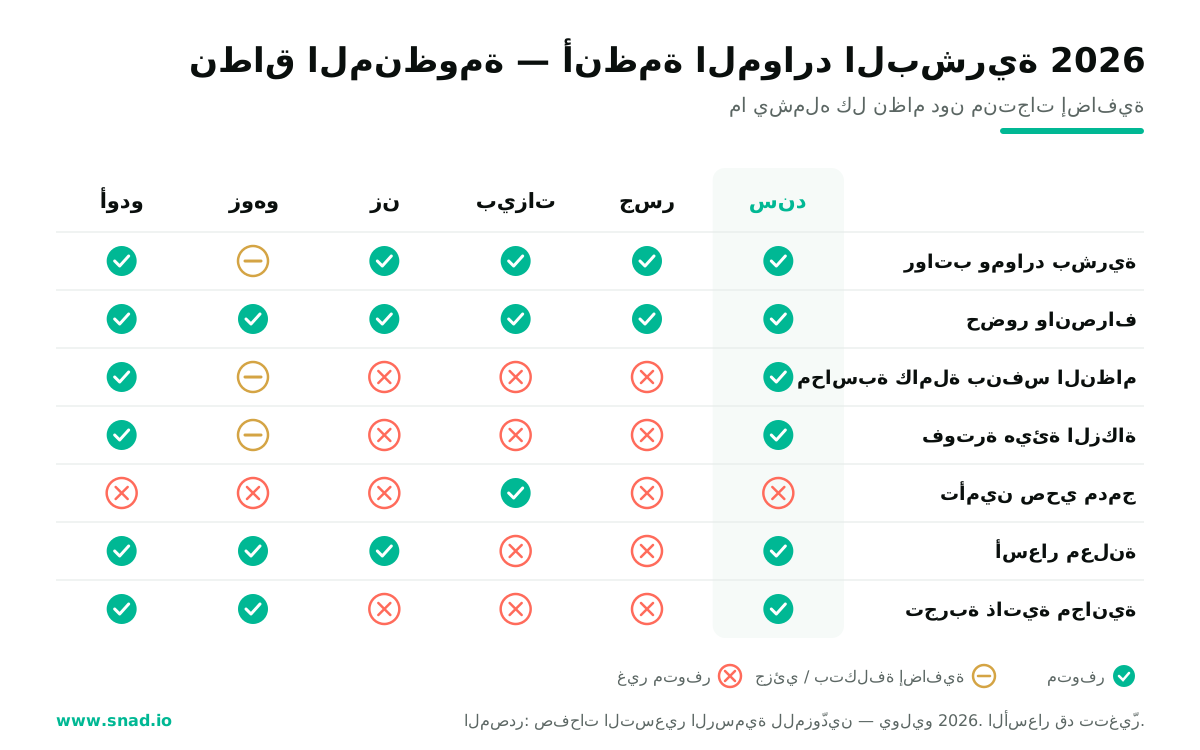
The picture per the vendors' official websites — August 2026 (“Ask the vendor”: not found documented on its pages in our verification round):
| Criterion | Snad | Jisr | Bayzat | ZenHR | Zoho | Odoo |
|---|---|---|---|---|---|---|
| Published price | From SAR 0, then SAR 149/month per plan | Does not publish prices (price via a quote request) | Does not publish prices (flexible pricing by size and modules) | From $8/user/month billed annually | Payroll from SAR 35 per company per month billed annually (People: free up to 5 users) | $13.50/user/month (annual) |
| Pricing model | Plan with a set number of users | Custom quote | Custom quote | Per user | People per user · Payroll per company + per additional employee | Per internal user |
| Automatic GOSI calculation | ✗ | Ask the vendor | Ask the vendor | GOSI module stated | ✓ via the Saudi Payroll product | Ask the vendor |
| Wage protection files (Mudad format) | ✗ | Ask the vendor | Ask the vendor | Ask the vendor | Wage protection module via Payroll | Ask the vendor |
| Accounting and invoicing in the same system | ✓ | Not listed among its bundles (August 2026) | Not listed among its products (August 2026) | Ask the vendor | Separate products | ✓ |
| Self-serve free trial | 7 days, no card | Ask the vendor | Ask the vendor | Ask the vendor | Payroll: 14 days, no card | Free plan for one app |
About Snad
Where Snad honestly stands
The verdict, without hedging:
- Choose Jisr if you want a specialist HR platform that covers talent and expenses, and you are comfortable with a price through a quote request and a separate accounting system beside it.
- Choose Bayzat if you want your employees' health insurance managed alongside HR on one platform.
- Choose ZenHR if you want stated Saudi localisation at a published per-user price, particularly under one hundred employees where implementation and training are free.
- Choose Zoho if budget is your tightest constraint and you can assemble multiple products yourself.
- Choose Odoo if you have a technical team and want every app at one per-user price with freedom to customise.
- Choose Snad if you want attendance-based payroll inside the same system that keeps your books and issues your ZATCA-approved invoices — on a published flat plan that does not inflate with every new hire, with a 7-day trial and no card.
The decisive question is simple: are you looking for the deepest standalone HR platform, or for an end to the sprawl of separate systems? Your answer is your choice.
Choosing by the size of your business
- 1–9 employees: add up the cost of a specialist system plus separate accounting software before you subscribe. One integrated system on a single plan (Snad from SAR 0) or Zoho People's free tier up to 5 users (with payroll in Zoho Payroll from SAR 35 a month) is the economic logic — and run your payroll numbers for free with the salary calculator before you subscribe to anything.
- 10–50 employees: this is where the scales balance: ZenHR priced per user billed annually, plus accounting software if its offer does not include it, versus an integrated system at SAR 149–399 that covers both. Remember that Snad is priced by the number of system users, not by headcount: Basic includes 3 users and Pro 5, and each additional user is SAR 20 per month — so a company with fifty employees may need only three or four users. Cost both sides on your own user count before you decide.
- 50–250 employees with complex compliance requirements: look seriously at the specialists (Jisr, ZenHR and Bayzat), and ask each of them for a written list of its government integrations. Weigh it against leaving your accounting in another system.
- Whatever your size: trial before you commit (where a trial is offered), and ask any vendor who does not publish prices for a written quote covering implementation, training and the fee for each additional employee — the surprises live in the details.
The comparison in brief, with its sources
The provider figures below come from each provider's own official page, on the access date given with each line. Prices change, so check the provider's page before you subscribe.
- Jisr: A Saudi platform specialised in human resources, with three bundles spanning core HR, payroll and attendance through talent management (recruitment and performance reviews) to expense management, travel booking and receipt automation. It does not publish prices on its website (August 2026): the pricing page shows the three bundles with feature descriptions and every section ends with “request a demo”. It specialises in HR, so accounting and invoicing fall outside its scope. (Source: jisr.net/pricing — accessed 13 August 2026; jisr.net/pricing7)
- Bayzat: A broad platform combining HR and payroll with group health insurance, employee benefits and payments (corporate cards and cross-border payments), plus automation tooling, reporting and an AI assistant. It does not publish prices on its website (August 2026): there is no pricing page and no “Pricing” link in the navigation, and its FAQ states “flexible pricing based on your company size, modules needed”. It specialises in HR and benefits. (Source: bayzat.com — accessed 13 August 2026; bayzat.com8)
- ZenHR: An explicitly published price — rare transparency in a category dominated by “request a quote” — together with stated localisation for the Saudi market (GOSI and Saudization), published free tools such as a Nitaqat calculator and a GOSI calculator, and broad regional coverage. Published pricing: Starts at US$8 per user per month billed annually (its official FAQ page). Pricing is in US dollars rather than SAR, and per user rather than per employee, with bulk discounts and no published tiers. Implementation and training are free under one hundred employees, with a one-time fee at one hundred and above. It specialises in HR, so accounting is a separate system. (Source: zenhr.com/en/faqs — accessed 13 August 2026; zenhr.com/en/faqs9)
- Zoho Payroll: Fully published pricing in Saudi riyals with a visible tier table, a dedicated Saudi edition with published compliance modules, per-organisation rather than per-user pricing that stays low for small teams, and a 14-day trial with no card. Published pricing: Standard SAR 35/month per organisation including 5 employees, then SAR 7 per additional employee (annual); Professional 55; Premium 75. A payroll product; employee and leave management sit in a sibling product, Zoho People, priced separately, and accounting in Zoho Books. (Source: zoho.com/en-sa/payroll/pricing — accessed 13 August 2026; zoho.com/en-sa/payroll/pricing10 · zoho.com/people/zohopeople-pricing.html11)
- Daftra: A widely adopted Arabic program serving several Arab markets, covering accounting, invoicing, point of sale, HR and fixed-asset management with three depreciation methods plus a no-depreciation option, per its asset-management page (November 2026). Published pricing on annual billing (monthly billing in parentheses): Basic SAR 95/month (120), Advanced 155 (220), Comprehensive 225 (320) (daftra.com/plans). Phase Two e-invoicing starts from the Advanced plan; Basic covers Phase One. The Basic plan is capped at 100 invoices/month and one user. (Source: daftra.com/plans — accessed 3 November 2026, depreciation methods accessed 3 November 2026; daftra.com/plans12 · daftra.com/en/asset-management13)
- Odoo: A large ecosystem with dozens of apps extending as far as manufacturing and project management, and its plans include support, hosting and maintenance. Published pricing: Standard US$13.50 per user/month billed annually and US$16.90 billed monthly. Pricing is in US dollars per user, with no SAR price on the page. On-premise hosting or Odoo.sh comes with the Custom plan. (Source: odoo.com/ar/pricing — accessed 19 August 2026; odoo.com/ar/pricing14)
Next: HR and payroll in Snad · Payroll in Snad · What HR software costs · Free HR calculators
Frequently asked questions
- What is the best HR software in Saudi Arabia in 2026?
- It depends on your need: Jisr suits anyone who wants a specialist HR platform with talent and expense bundles (price via a quote request); ZenHR suits anyone who wants Saudi localisation and a published price (from $8 per user per month billed annually); Bayzat suits anyone who wants group health insurance alongside HR and payroll; Zoho suits anyone willing to assemble the products themselves (People is free up to 5 users); and Snad suits anyone who wants attendance-based payroll inside one system alongside accounting and e-invoicing, on a plan from SAR 149 per month.
- Is the Mudad platform mandatory for my business?
- Compliance with the Wage Protection System is mandatory for every private-sector establishment regardless of size — it was phased in down to establishments with one to four workers as of December 2020 — and Mudad is the official channel for proving compliance by uploading wage files monthly within 30 days. The payroll system inside Mudad itself is optional, and good HR software prepares either the upload files or the reports behind them for you.
- How much does HR software cost in Saudi Arabia?
- Per the official websites in August 2026: Zoho Payroll in its Saudi edition from SAR 35 per month for the company including five employees, then SAR 7 per additional employee billed annually (Zoho People has a free plan for up to five users, and its paid tier figures could not be documented), ZenHR from $8 per user per month billed annually, Odoo at $13.50 per internal user billed annually, and Snad on flat plans from SAR 0 then SAR 149 per month for five apps, all nine on Pro. Jisr and Bayzat do not publish prices on their websites — quotes are custom through sales.
- What is the difference between a dedicated HR system and an all-in-one system that includes HR?
- The specialists focus on HR, and Jisr's bundles and Bayzat's listed products do not include accounting and invoicing (August 2026), so you run the accounting in another system you buy and connect separately. The all-in-one systems (Snad, Odoo) run payroll off the same database as the accounting, so the payroll run posts its own journal entries and employee cost appears in your financial statements immediately.
- Does HR software calculate GOSI contributions automatically?
- Serious systems operating in Saudi Arabia calculate GOSI contributions automatically at the official rates by employee nationality. What we could document (August 2026): ZenHR states a GOSI compliance module, and Zoho Payroll in its Saudi edition states GOSI and wage protection modules; ask any other vendor for written confirmation. Always verify that the current rates are being applied, and check the result against the free GOSI calculator on our site.
- Is per-employee pricing better than a flat plan?
- It depends on your growth: variable pricing — per user on ZenHR, per additional employee on Zoho Payroll — is very fair for small, stable teams but rises with every addition, so cost it against the number of users or employees you expect rather than today's. A flat plan priced by administrative users (Snad from SAR 149) stays the same however many employees you add, as long as the admin team is unchanged. Cost it at the size you expect to be in two years, not the size you are today.
- What is the difference between payroll software and an HR system?
- Payroll software calculates wages and produces the monthly run, and its inputs — attendance, leave, advances — are keyed into it. An HR system manages the full employee lifecycle — contract, documents, attendance, leave, advances — so those inputs become recorded data that flows into payroll automatically. The practical difference is how many manual steps precede each run.
- Why do some systems not publish their prices?
- Because their pricing depends on headcount and the modules required, so quotes are built case by case. Jisr and Bayzat are two examples: their pages show bundles and features and end in a demo request, with no published figure (August 2026). That is evidence of neither high nor low pricing, but it does mean you will not know your cost before a sales cycle — so ask for the quote in writing, including implementation lines.
Sources
External links in this article, in the order they appear.
- 1Jisrjisr.net
- 2Bayzatbayzat.com
- 3ZenHRzenhr.com
- 4Zoho Peoplezoho.com
- 5Odooodoo.com
- 6Mudad platformmudad.com.sa
- 7jisr.net/pricingjisr.net
- 8bayzat.combayzat.com
- 9zenhr.com/en/faqszenhr.com
- 10zoho.com/en-sa/payroll/pricingzoho.com
- 11zoho.com/people/zohopeople-pricing.htmlzoho.com
- 12daftra.com/plansdaftra.com
- 13daftra.com/en/asset-managementdaftra.com
- 14odoo.com/ar/pricingodoo.com